

Civilisational erasure?
In Paris, London and Florence, hardly.

What does it even mean, civilisational erasure? Since President Trump wagged his finger and suggested Europe was doomed due to migration, there has been a lot of pushback. Including the point that by 2050 the overall population in Europe will be about 700 million (source: UN), with an Islamic population of about 75 million. As a correspondent to The Times pointed out, “a 10% minority population hardly constitutes an existential threat to European cultural identity.”
When we studied the rise and fall of civilisations at school, I remember one of the abiding tenets was that the existing civilisation had to be perilously weak in order to be erased. With this in mind, this week’s Arts Stack includes experiences in Paris, London and Florence; cities which over the last 600 years have been epicentres of European civilisation. Are these places ready to be erased?
In Paris, I saw the Marriage of Figaro at the Opera Garnier. The production (see The Arts Stack 4/12/25) was not flawless, but it was beautifully executed to a full house with élan – one might even say, panache, and musically it was wonderful.
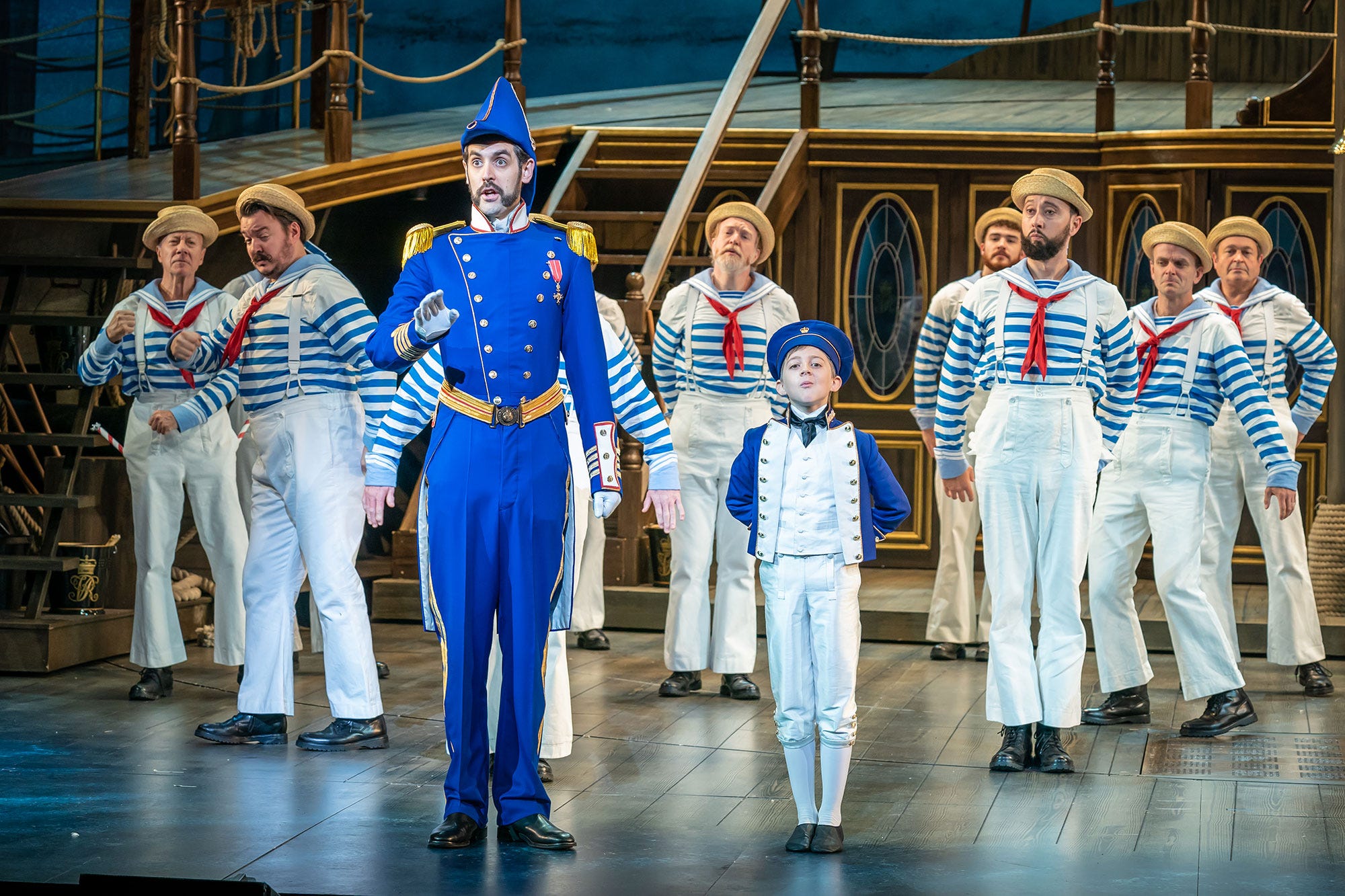
John Savournin as Capt. Corcoran leading the doughty crew of HMS Pinafore
In London, we revelled in the warm bath that is HMS Pinafore from English National Opera at the Coliseum. Performing to a packed house echoing with laughter and shouts of “Bravo”, this was a delicious, colourful night full of smutty jokes, hooped skirts and tap shoes. The enunciation of WS Gilbert’s satirical and hilarious verses was perfect, thanks to the presence of G&S stalwarts such as John Savournin, playing Captain Corcoran. Savournin is a man who must surely receive some sort of gong before long, for services rendered to Victorian rhyming couplets. At the end, the entire company waved an dizzying array of different flags to reveal its wholly international nature. More cheers. No suggestion of civilisational erasure here, either.
From enunciation, to Annunciation (!) In Florence, at the monumental Palazzo Strozzi to see the glorious and scholarly Fra Angelico exhibition, which runs until January 25 2025. This show, which is at the monumental Strozzi as well as the Museo St Marco, is a must-see for a deep dive into the Early Renaissance. It also reversions the legacy of the artist, as Fra Angelico is presented not as a decorative side-bar, but one of the formidable early architects of the era.
This was is the ideal show. Full, (but not rammed, Vermeer-style) and also not too long. With 150-or so art works, you can cruise around the Strozzi in about 90 minutes, then wander up to the Monastery of St Marco for another hour or so to see the artist’s frescoes decorating the dormitory cells of his own order.
What is so remarkable about Fra Angelico is that he couches a radical and revolutionary vision within an unwavering expression of faith. The only comparable artist I can think of who does this, is JS Bach. Every single picture by Angelico comes from deep religious conviction and dedication to Biblical stories.
Yet do not be lulled into some sort of cosy backwater. There is daring innovation within the traditional subject matter. This is an artist who achieved volume and emotional engagement in his figures, linear perspective for the rooms in which they sit, a light source, drama, shadows, drapery revealing knowledge of bodily form, and scientific exactitude with regard to plants and flowers. In 1420.
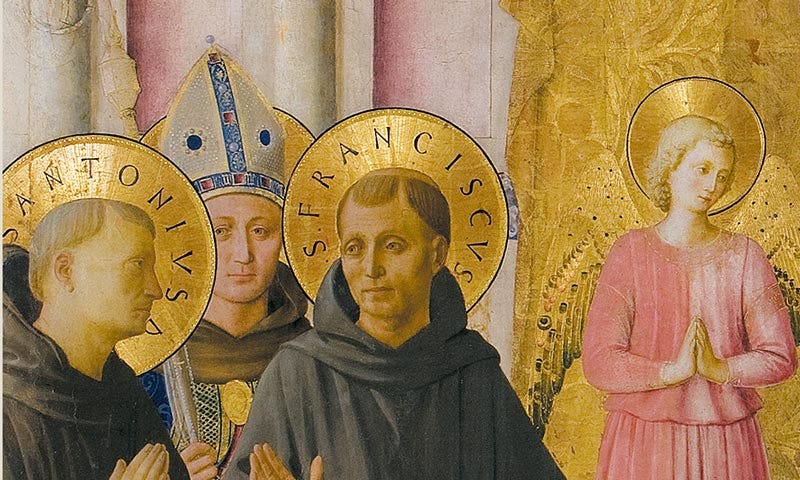
Real people.. The Bosco ai Frati Altarpiece (1450), Fra Angelico
To put this into some sort of perspective, da Vinci was doing this 75 years later. That is rather like a painter picking up on the development of Cubism around about the time that Damien Hirst won the Turner Prize, if you can imagine that.
The trouble, (if you can call it that), with Fra Angelico is that a) all that delicate beauty is distracting and b) innovation is easier to spot when it is presented on a sea shell, as in Botticelli’s Birth of Venus. When it comes to the early 15th century, we are typically surrounded by so many Gabriels and Virgins that when an artist does something different with the familiar setup, it is sometimes easy to walk right past it. Indeed, the Victorian art critic John Ruskin said of Fra Angelico that he was “not an artist, properly so-called, but an inspired saint.”
This exhibition, populated by what looked to me a highly diverse and also quite young audience, and brilliantly curated by the American Carl Brandon Strehlke from the Philadelphia Museum of Art, puts an elegant two fingers up to Ruskin, showing that Fra Angelico was not only acutely aware of the innovations, but wholly determined to deploy them.
Examine this Annunciation, from the small Tuscan town of San Giovanni Valdarno (which happens to be the birth place of that other Early Renaissance giant Masaccio).
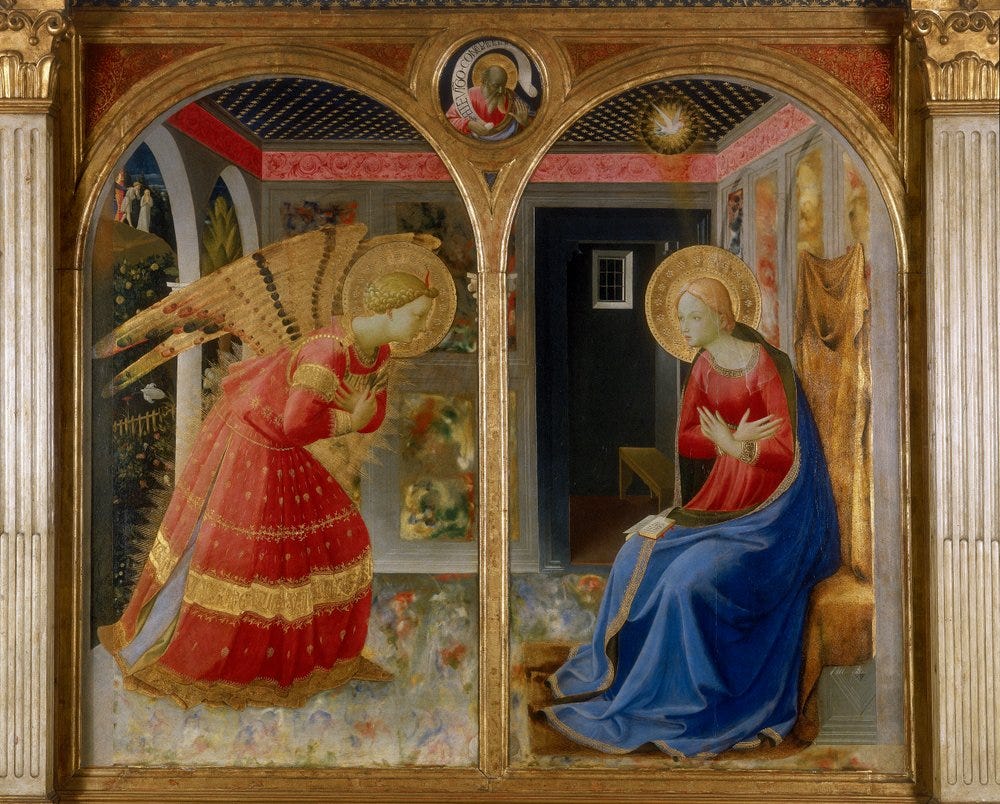
The Montecarlo Annunciation (1432), San Giovanni Valdarno, Fra Angelico
The seriousness and intent with which Gabriel looks at the Virgin is inescapable. The room she sits in, is an actual space, with light coming in from the left and a believable back wall. The arches on the left reflect the panels on the front, and make the whole space work architecturally.
If the Palazzo Strozzi is overwhelmingly glorious, all gold leaf and shimmering colour, the Museo St Marco reveals how Fra Angelico brings his radical vision for a new realism with a far more restrained palette.
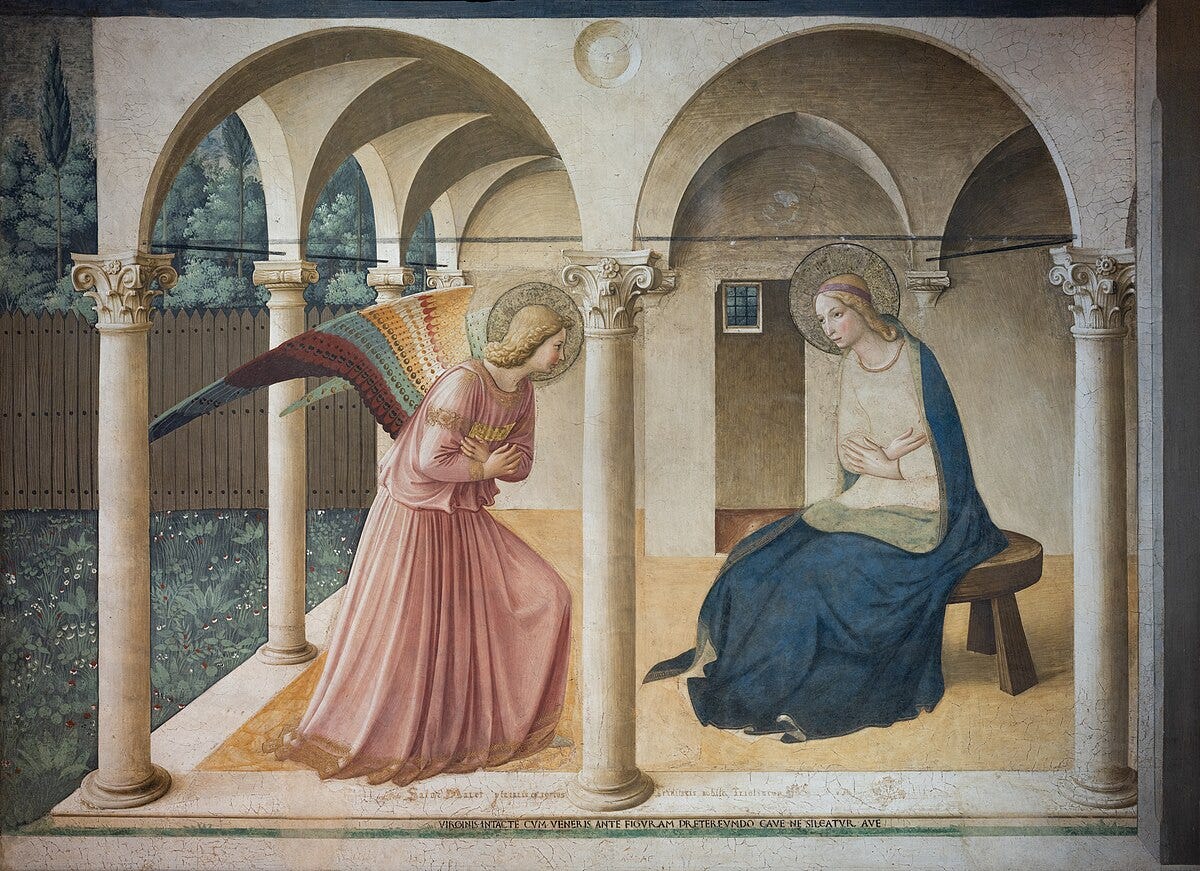
Annunciation, Museo San Marco (1437) Fra Angelico
Turning the corner on the stair to encounter Fra Angelico’s Annunciation here delivers a monumental experience. Here is the angel, again, single minded, fixated on transmitting his news to the Virgin. Here is the Virgin, once more acknowledging the honour, but returning his gaze as an equal. Here are weight-bearing columns with Corinthian capitals, outlining a believable, geometric space in which the characters exist, and the grass outside full of identifiable plants. Gabriel’s wings are a chromatic glory, darkening as they curve over horizontally towards the viewer. What a thing to take in on your way to the refectory for lunch.
As we left the Museo St Marco, the bells were chiming and the Christmas market was bustling in the square of the Innocents decorated by Andrea della Robbia. People were laughing, buying stuff, eating cake, drinking chocolate. Civilisational erasure? Give us a break.
It's going strong. Not sixty years ago Kenneth Clark was hailed as a messiah in America for communicating the glories of European civilisation to the US. What was that line - 'Some people say that they would prefer barbarism to civilisation. Well, they probably haven't given it a long enough go' (or something of the sort).
Absolutely right, Rosie! This is a welcome, if not vital riposte, with facts and truths as substantiation, to those racists, for that is exactly what they are, bemoaning the presence among us of peoples and cultures from outside the so-called classical canon.
European civilisation has historically endured wave after wave of real incomers and the cultures they’ve brought with them that only enriched our own cultures.
Where would we be today without Arabic numerals? Or algebra? Think GCSE Maths would be more interesting or easier with Roman numerals?
Where would we be without the influence of Jews, who, after all, originated from the very same places many of those Muslim mathematicians and scientists did, who have hugely influenced local cultures wherever they landed in Europe?
In 20th century English literature, where would we be without those fabulous writers whose families originated in that great melting pot of culture and civilisations, India? If Salman Rushdie was white, I’d have no doubt he’d be lauded as the greatest living writer in English. And he’s not the only one from somewhere else who’s greatly enriched our ‘civilisation’; Hanif Kureishi, Bernardine Evaristo, Chimamanda Ngozi Adichie, Derek Walcott…I could go on (and usually do…ha-ha!).
So, yeah, Rosie…we are alive and kicking!