

Legacy
You can ask any question in Hull

Legacy - of anything funded by the public purse- is and should be, interrogated regularly. Of the Olympics (in whatever nation), of the Festival of Britain, even of the Great Exhibition.
It’s a question Bradford City of Culture will be asking this year, as it was at Hull when it was City of Culture in 2017. The Board (of which I was Chair) started considering legacy several years before the festival started. It was the first question we asked. It is still being asked, quite rightly.
What is or was the legacy of the £35 million spent on and in Hull 2017?
I have books devoted to analysing this issue. I’ve got three cuttings files, with newspaper and magazine articles devoted to Hull City of Culture. I’ve spoken to PhD students about it. I’ve been on podcasts, radio programmes, live TV debates.
If I ever did Mastermind, this would be my special subject.
I know the data, I know the figures. I can talk about the legacy of culture, jobs and income, or the equally vital and real legacy of memory. If you want to have either a polite conversation, or an angry argument about it, I’m there. I can be relied on to politely knock your argument into smithereens, or laughingly back you up.
However.
Two things happened this week concerning the legacy of that £35 million, which I thought worthy of coverage on The Arts Stack.
National Geographic has delivered its list of the 25 best places to visit IN THE WORLD. In the World!! Hawaii is in there, as are the Dolomite mountains in Italy. As is Hull. Here’s how the publication sees it. Hoorah!
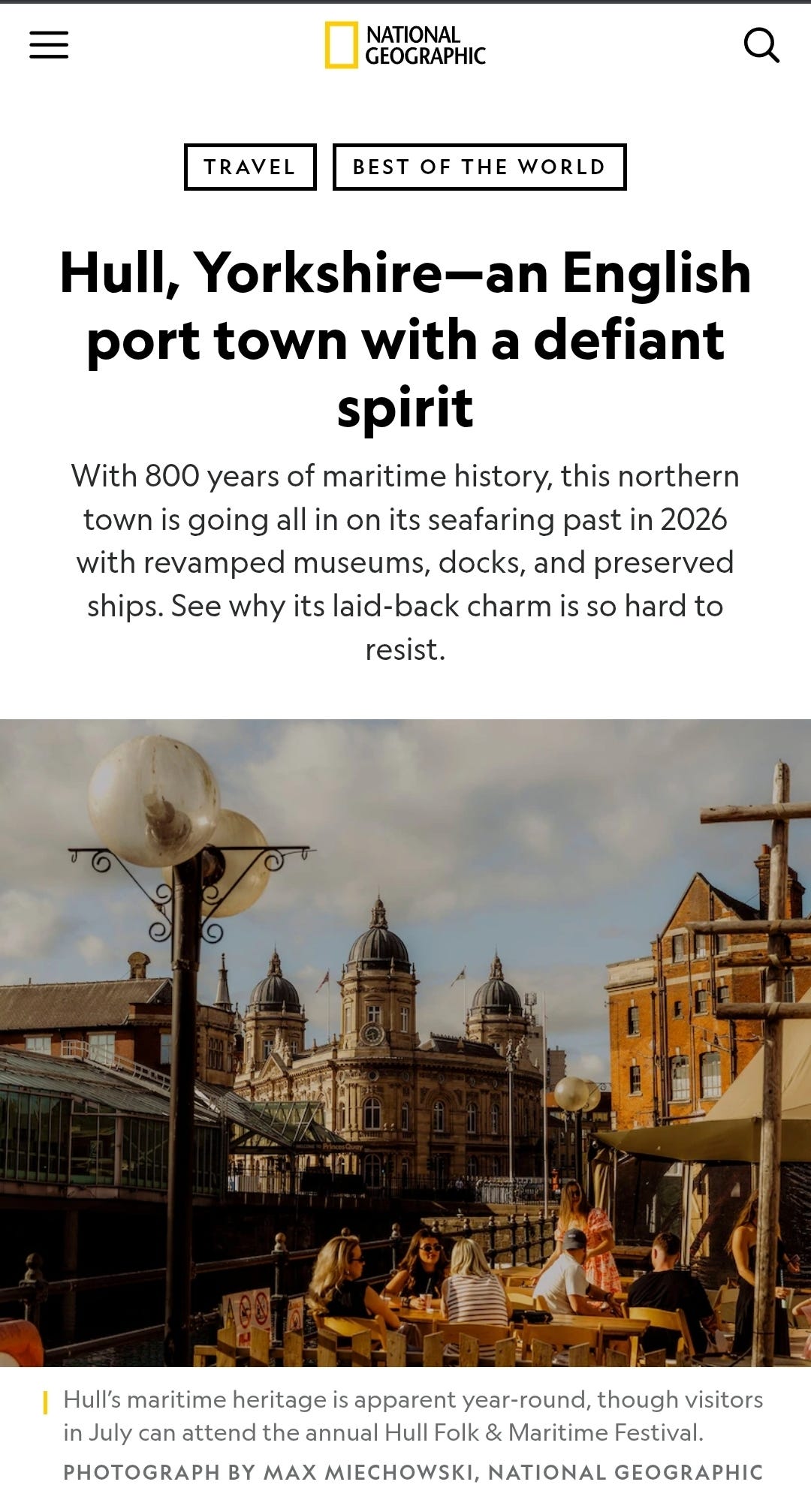
Well, of course. But people in the UK thought that was really funny, so it made it onto the national news.
I know. Let’s all laugh at Hull and its ambition. Fine. If that’s what it takes to make the city onto the news, then great. There are still people out there, such as a know-all whom I met last week, who told me in no uncertain terms that the big theatre in Hull, which was rebuilt in 2017 (at a cost of £16 million in addition to the £35m across the city), and is Opera North’s favourite place to play, was absolutely rubbish and had no acoustic worth considering. The fact he hadn’t been to Hull since 1973 was of course irrelevant.
Anyway, the BBC went and interviewed people in Hull, who of course thought their city’s inclusion in the National Geographic World Survey was bang to rights and absolutely as it should have been. One person actually mentioned the City of Culture as the turning point. And the BBC included the picture of the opening ceremony. Here it is.
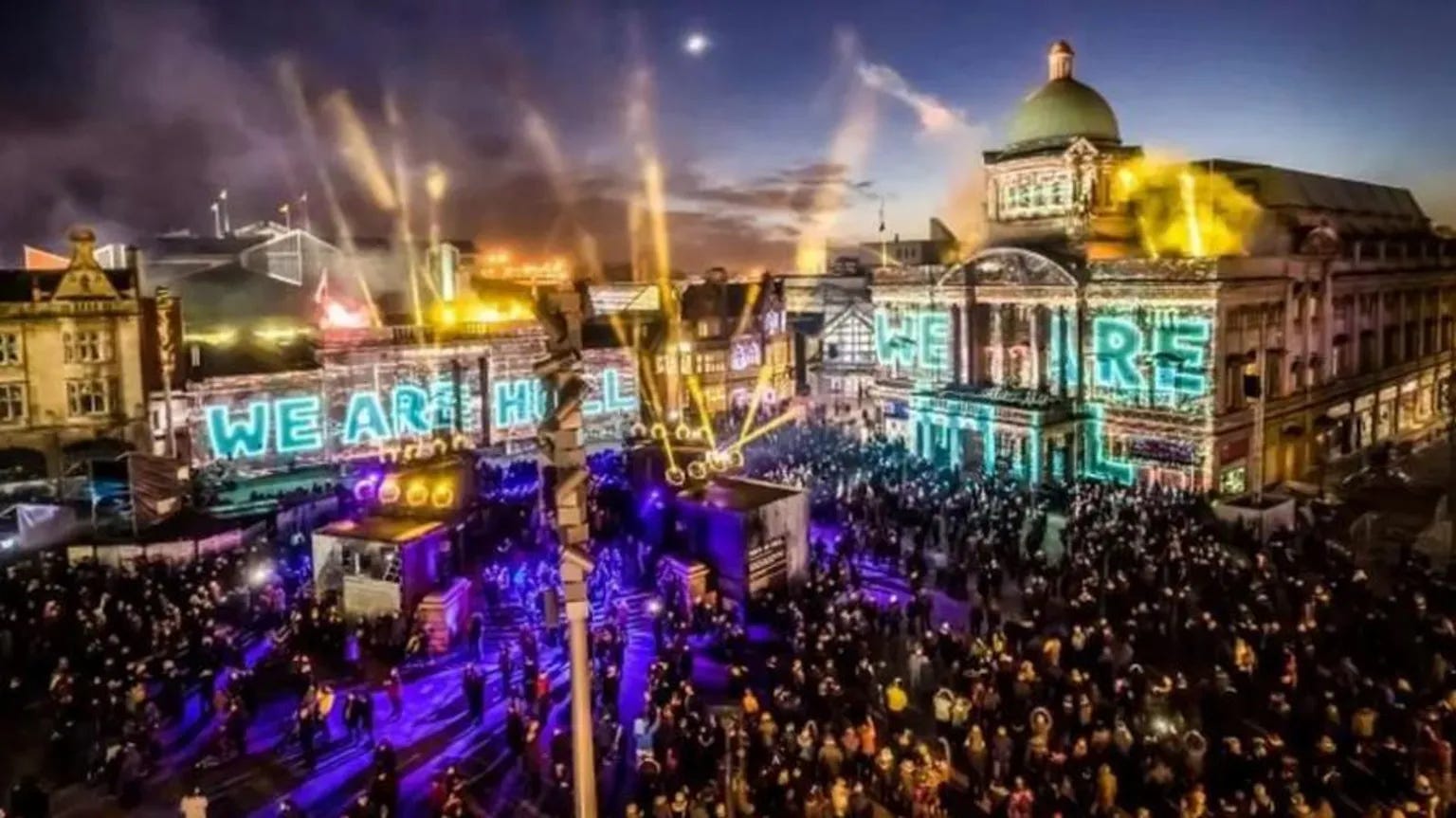
I’m in the crowd somewhere here, crying.
I sent the coverage to the then Leader of the City Council, the wonderful Steven Brady OBE, and the CEO of Hull 2017, the equally wonderful Martin Green CBE, (who is now in charge of Eurovision).
But then something else happened. I heard about Curiosity. No, not the 1980’s boy band, (I was a huge fan), but an art project in Hull, a project whose range, daring and ambition was perhaps inspired by the City of Culture.
The city whose university Librarian was one of Britain’s greatest modern poets, has decided to use its 13 public libraries to become a City of Curiosity. Funded by the James Reckitt Foundation, it is the single biggest funded event happening in libraries in the UK. It describes the project as “the ultimate Ask Us Anything”.
“Curiosity is a movement toward greater understanding, increased knowledge and ingrained accuracy.
Taking questions, queries and requests from members of the population of Hull, Curiosity strives to provide the best, correct guidance and answers.
All content is made by the people of Hull, scrutinised by librarians from Hull’s public libraries and presented as accurately and helpfully as possible.
Curiosity is brought to you by the James Reckitt Library Trust, which has dedicated the last 100 years to increasing the provision of public libraries in Hull.”
It’s led by Hull University emeritus Professor Graham Chesters and programmed by Dave Lee, writer and musician who is something of an urgent artistic presence in Hull. One of his films is this one, of Larkin’s paen to Hull
What do you want to know? Curiosity will answer any question you have. Not necessarily about Hull, but plenty are. Curiosity is an art work and has become a project.
These are some of the questions asked. It’s a bit like a radio phone in, only wittier.
Some questions turn into the Curiosity Cast podcast, hosted by Lee and Dave “Burnsy” Burns, a former Radio Humberside legend. This week their focus was on Bombed Buildings, the name of work by Hull-based artist Stewart Baxter, who with his collaborators has decided to make music out of a destroyed space.
There are many bombed, derelict buildings in Hull. It was the most targeted city after London in the Blitz, and there are still places where the rubble remains. Baxter went to an old Georgian house. He discusses the position of making something from nothing, both as a child growing up in a low-income family in Hull and as an adult artist and musician whose ambition to make it was put on hold during lockdown. But then, in the months after, things started to fall into place.
“I got a commission to make a short video from Absolutely Cultured”, says Baxter, mentioning the company which used the remaining funds from Hull 2017. “And then Freedom Festival booked me to make an outdoor performance…”
It is a story of how a city’s combination cut-price venues and a small connected, confident arts base can help an artist to make work. “We set up in the space and we just pressed record and experimented,” says Baxter but the piece came from a traumatic childhood.
“The original title was ‘Dog In the Back of a Ford Cortina Estate.’ It was when we moved into what I remember as our second house and my mum was really house-proud. Everything felt good. One day we got a knock on the door. A man said you have an hour. Take what you can get and the rest is ours. You’re out….It transpired my mum was in loads of debt…the house got repossessed. I just remember my dad shoving the dog onto the back of all these cases in the Ford Cortina. After that, nothing was ever the same.”
Baxter recorded his improvisation with an orchestra, didn’t know what to do with it, and decided to cut it straight onto vinyl, with a lathe machine provided by a restorer in Leeds. But not just any lathe machine.
“It’s a 1940’s Presto machine which turned up in central Europe somewhere. And it was one of two machines used to record the Nuremberg trials. They were recorded onto this machine.”
So a project made in a city remodelled by the Second World War was recorded via a machine used in the Nuremberg trials. “None of this was planned,” says Baxter, somewhat unnecessarily. “It got me really excited about releasing music. Because this is what I want to do. I want to make a very limited amount of records…for a small community in Hull…and make it like an art edition, not a record.”
He made 20 and sold 10 on the opening night. The records all have different B sides (basically voice notes recorded by different poets) and with specially designed sleeves created by a local photographer and printed by Hull paper legend G.F. Smith.
A complete art work. Hand printed, specially cut, uniquely composed in response to an abandoned Georgian house in Hull.
“It’s the exact opposite of Spotify and streaming,” says Burnsy. Baxter has the final say.
“Each record is sold for £103.88, which is the cost of a year’s subscription to Spotify. Cancel your subscription and buy a real piece of art! Its a unique item. There are 20 in the world. It’s a performance of an improvised piece of music in a space nobody has been in in a building people don’t use and sell a record people don’t usually pay for, like a piece of art…in a city like Hull, its a proud moment.”
Another super read! Wouldn’t it be great if more cities adopted the ‘City of Curiosity’ concept? As a former information professional it does my heart good to learn that libraries are not going down without a fight. Zadie Smith wrote an excellent piece in praise of the British Library in yesterday’s Guardian. Here’s to an increasing public curiosity and those who work to provide the answers to our questions!
Thank you, Rosie. You’re a great ambassador for our unusual city, a place that lets you create.