

Young in art
How the Centre Pompidou is winning over the Millennials

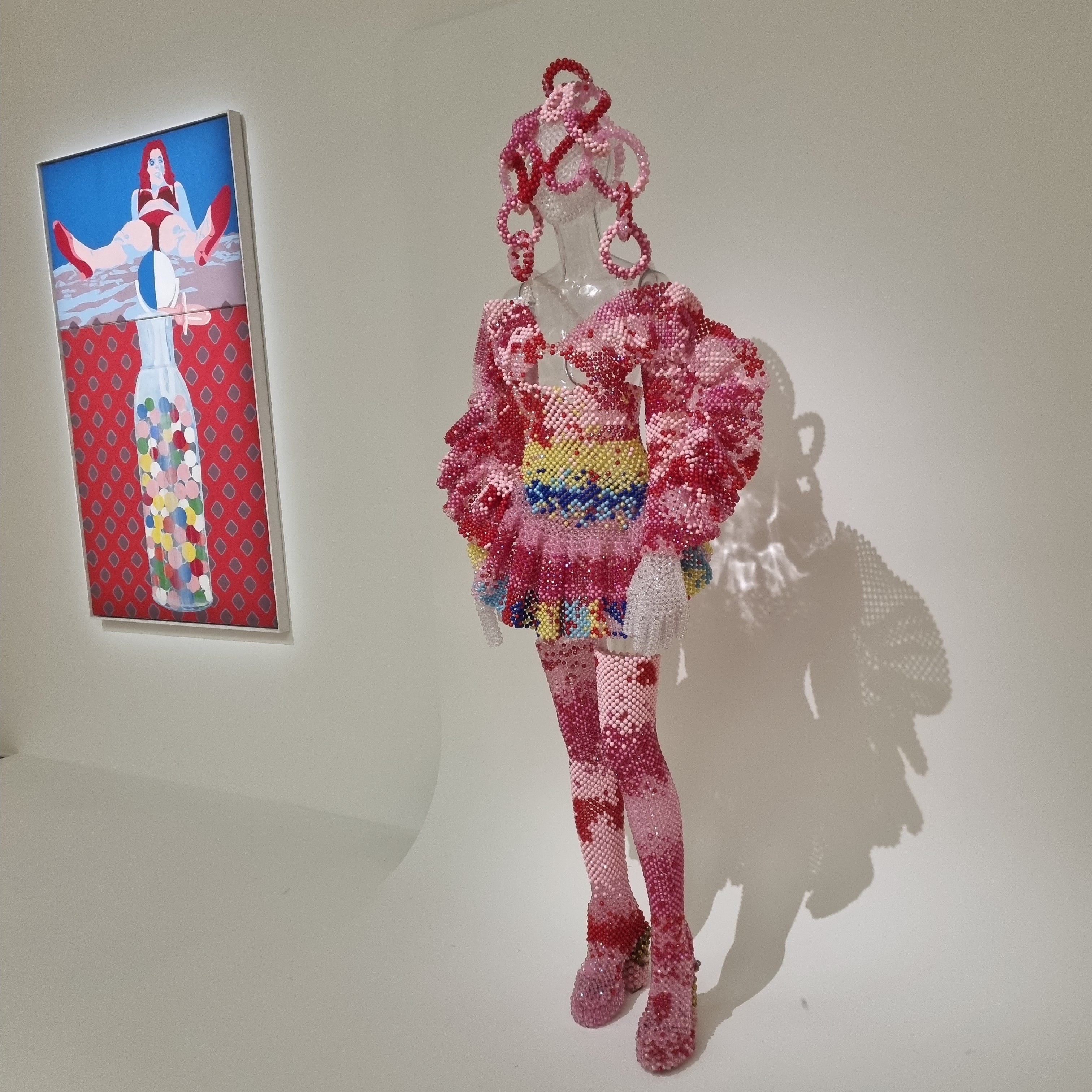
Walk this way…at the Centre Pompidou (art by Ulrike Ottinger, outfit by Kevin Germanier)
It is the Holy Grail of all national galleries, ditto for the Arts Council of England. Getting young, diverse people to be part of the art world. Not just those on school trips, or tourists. There’s no problem with older people whose habits were formed before screens and streaming. Can’t keep them away. But the Instagram generation?
It’s not only about a financial barrier. As you read this piece, there will be about ten times more Milliennials down at the Van Gogh Immersive in London, or Manchester, or wherever, paying nearly £20 to see a pixellated image of Sunflowers, than there will be at the National Gallery, where they can see the actual original painting free of charge.
Other national collections are the same; any regular visitor to, say, the permanent collections of Tate’s various incarnations around England, Liverpool’s Walker or the National Gallery of Scotland in Edinburgh can’t fail to notice the fanbase, namely a large amount of elderly, white people walking slowly round the masterpieces. Why don’t young people join them?
The excellent charity Art History Link Up has recently suggested the difficulty of getting young people into galleries is due to the rigidity of the National Curriculum, which has led to a general collapse of History of Art as a subject in state schools. This means that children and young people are not introduced to the chronological spine for the story of art and so, unless their parents or someone who knows stuff can help them, they will not be able to find their way around the permanent collections successfully. Maybe.
It might be the way the work is shown; on the walls in respectful, serried ranks. On its own and without relation to anything else. Curators are trying to leave this behind. Tate Britain has just opened a show of the work of John Singer Sargent, Sargent and Fashion, which displays the outfits worn by his models alongside the paintings. The Centre Pompidou has gone one step further with its show La traverse des apparences (Bridging appearance), subtitled La mode au Centre Pompidou, curated by Laurenc Benaim. In essence, Benaim has selected key pieces of haute couture from 1925 to the present day, alongside masterpieces of modern art. In terms of audience profile, the Holy Grail is currently in the building with the pipes on the outside.
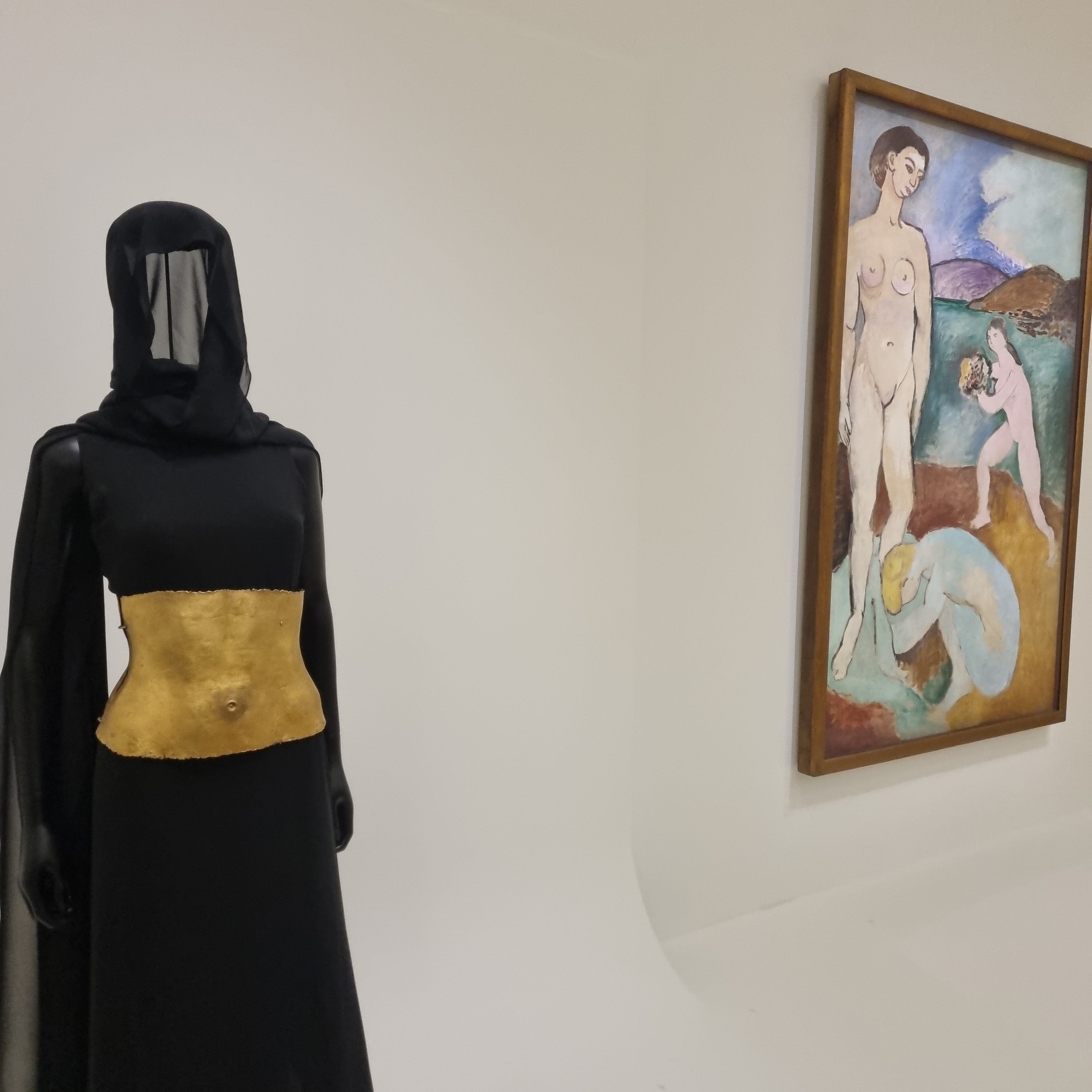
Saint Laurent meets Matisse
The show is on Level 5, where the permanent collection resides. Seventeen pieces of clothing are put on dummies beside seventeen works of art, in order to start a ‘conversation’ with them. (And by the way, reminding everyone that the French have always considered couture a work of art.) There is not a confusing array of clothes, either, which sometimes dulls by repetition. Just one perfect piece, connecting with a selected work of art.
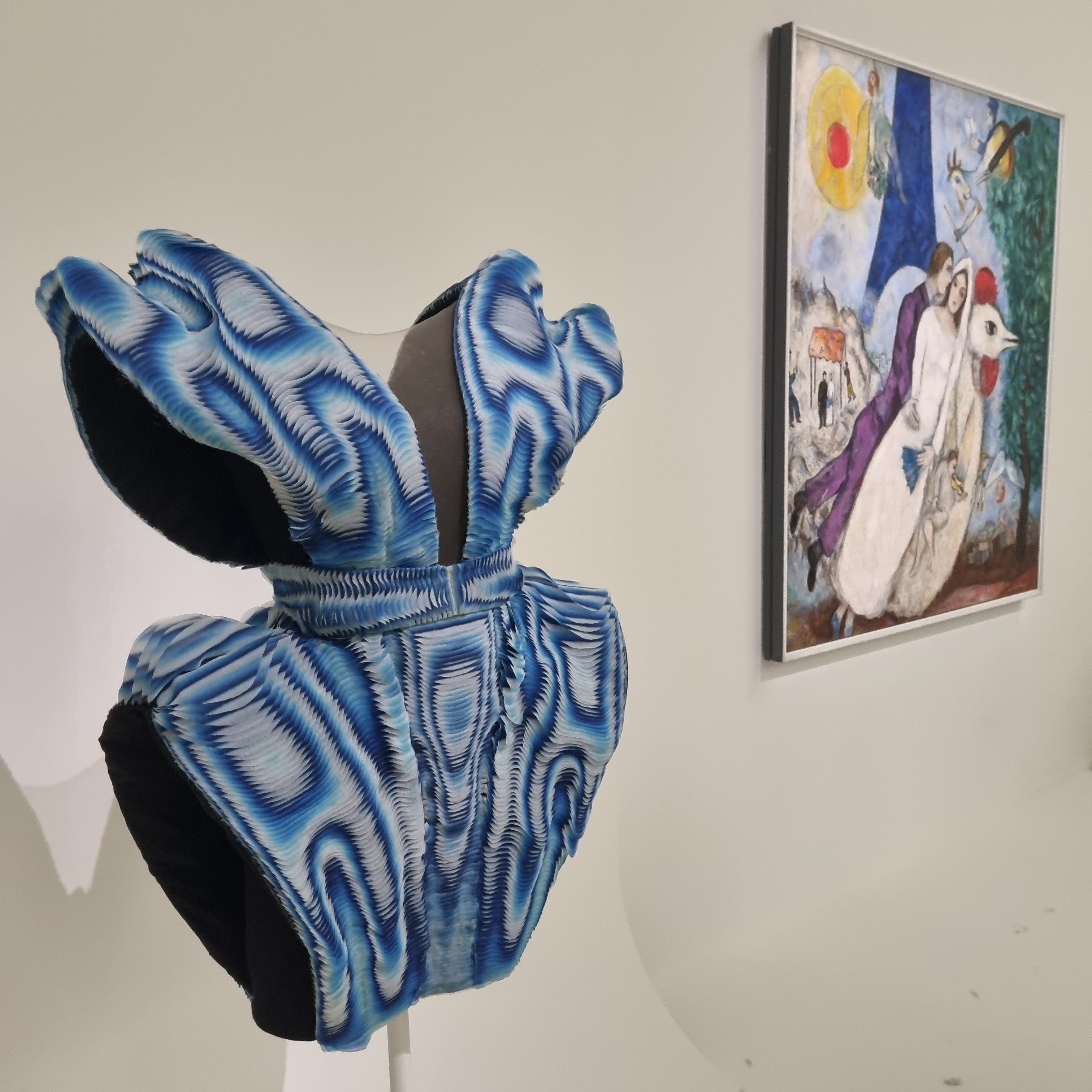
A dreamy painting by Chagalle of him and his wife flying past the Eiffel Tower, as seen above, is exhibited beside an equally dreamy blue and green winged souffle by Iris van Herpen. A perfect, silk Little Black Dress designed by Chanel between 1925-1930, is exhibited alongside a 1927 society painting by Christian Schad. And of course Jean Paul Gaultier’s 1999 iconic, conical corset, instantly associated with Madonna in her Blonde Ambition tour, makes an entrance. Here, it is presented beside a 1937 surrealist piece by Wilhelm Freddie, while a trompe l’oeil Lanvin dress designed by Alber Elbaz is exhibited by a Martial Raysse portrait, seen below. What a juxtaposition! No wonder social media is buzzing with these images.
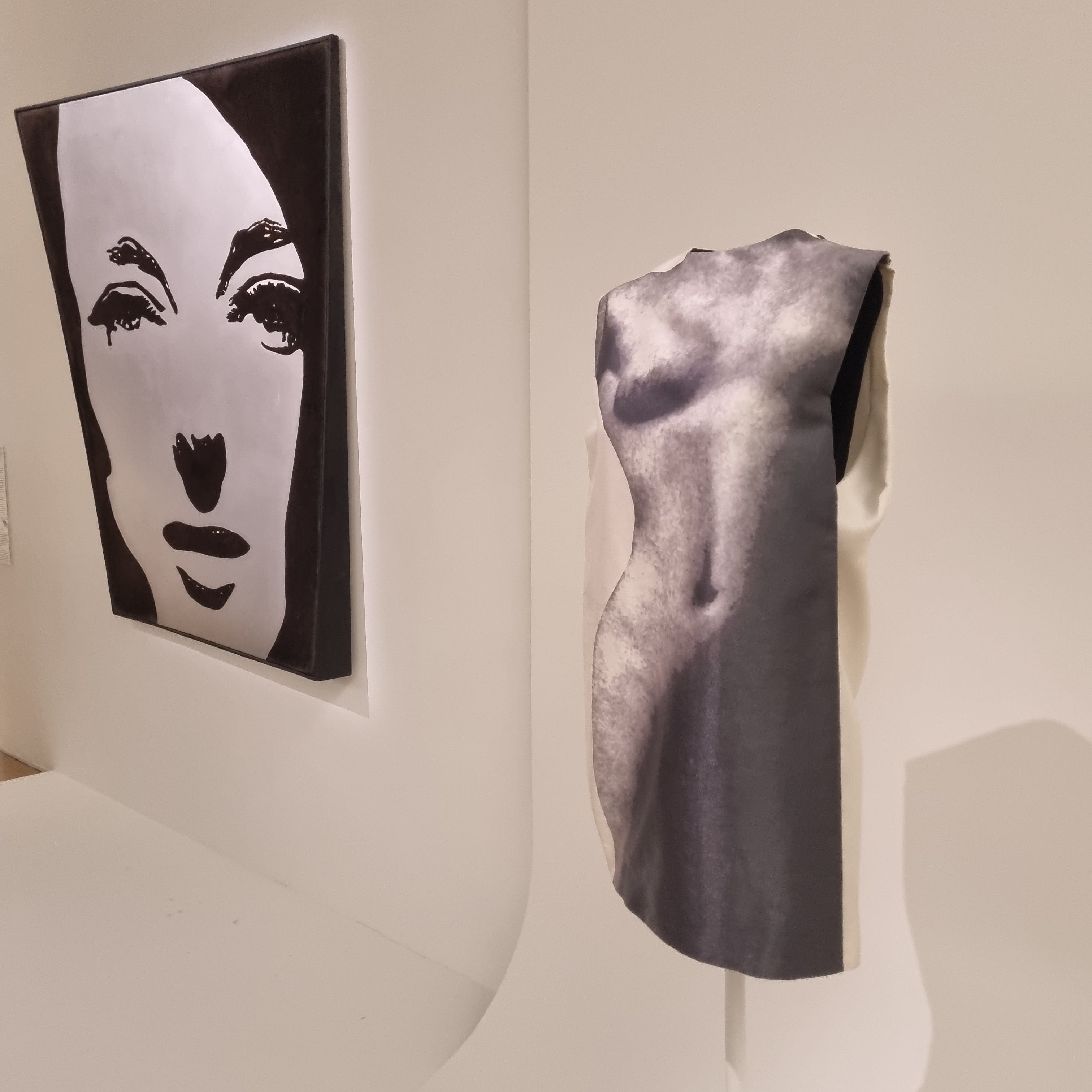
Not only do we look at these sculptural, perfect pieces in their own right, but Benaim has made the genius move of not putting all of them beside the gallery’s greatest hits. So you are forced to assess lesser known pictures and artists and as such, gain a deeper understanding of the Centre Pompidou itself.
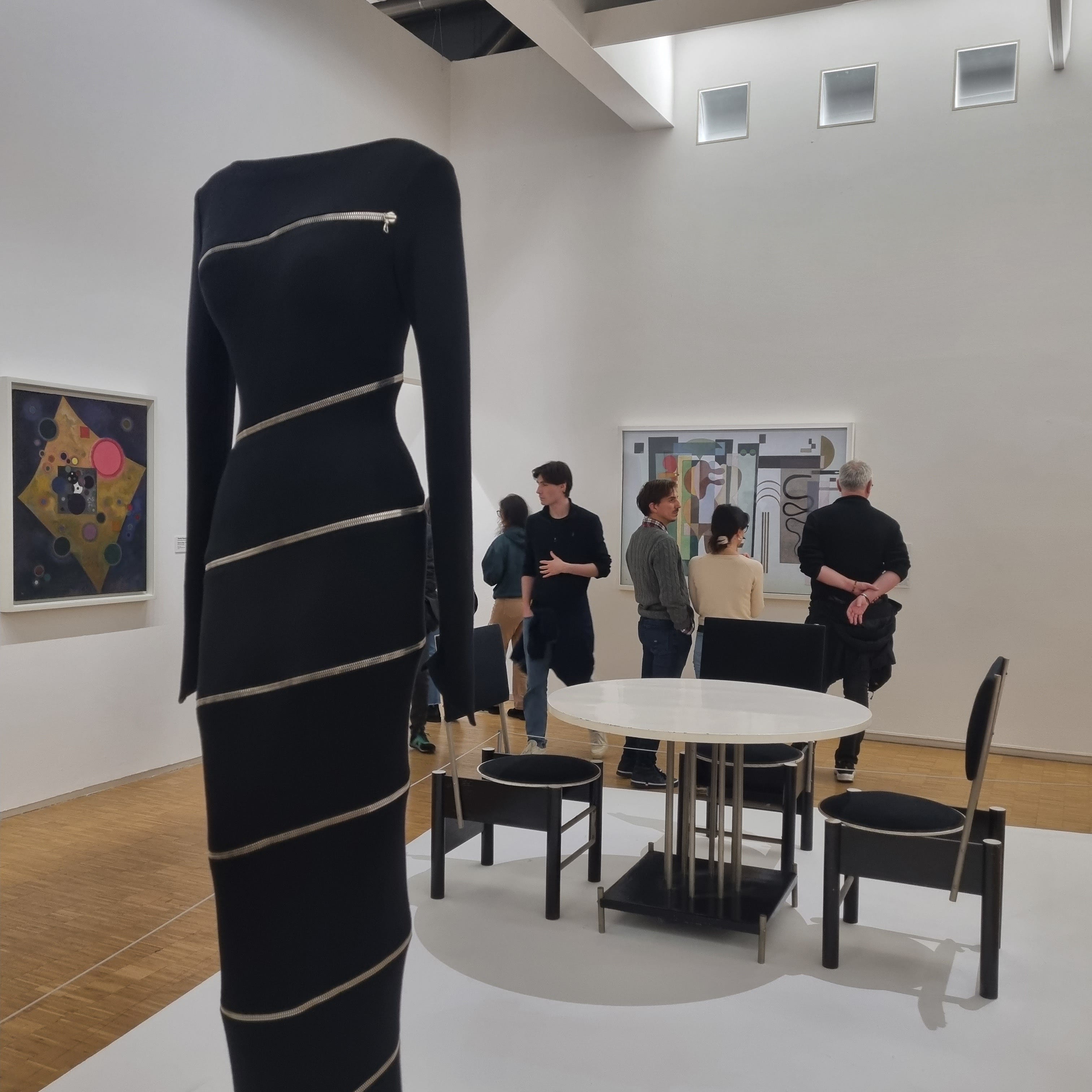
Alright, a 1969 Saint Laurent gown stands beside Matisse’s Le Luxe I, but it is Sonia and Robert Delaunay, not just the more famous brother, who are twinned with a recent concoction by Charles de Vilmorin, and furniture by Marcel Breuer which goes beside a stunning Azzedine Alaia zipped construction, seen above.
As I was gliding from outfit to outfit, a handy map as my guide, I could see there was a radically different audience thronging the fifth floor of the Centre Pompidou. Young, diverse, phones at the ready.
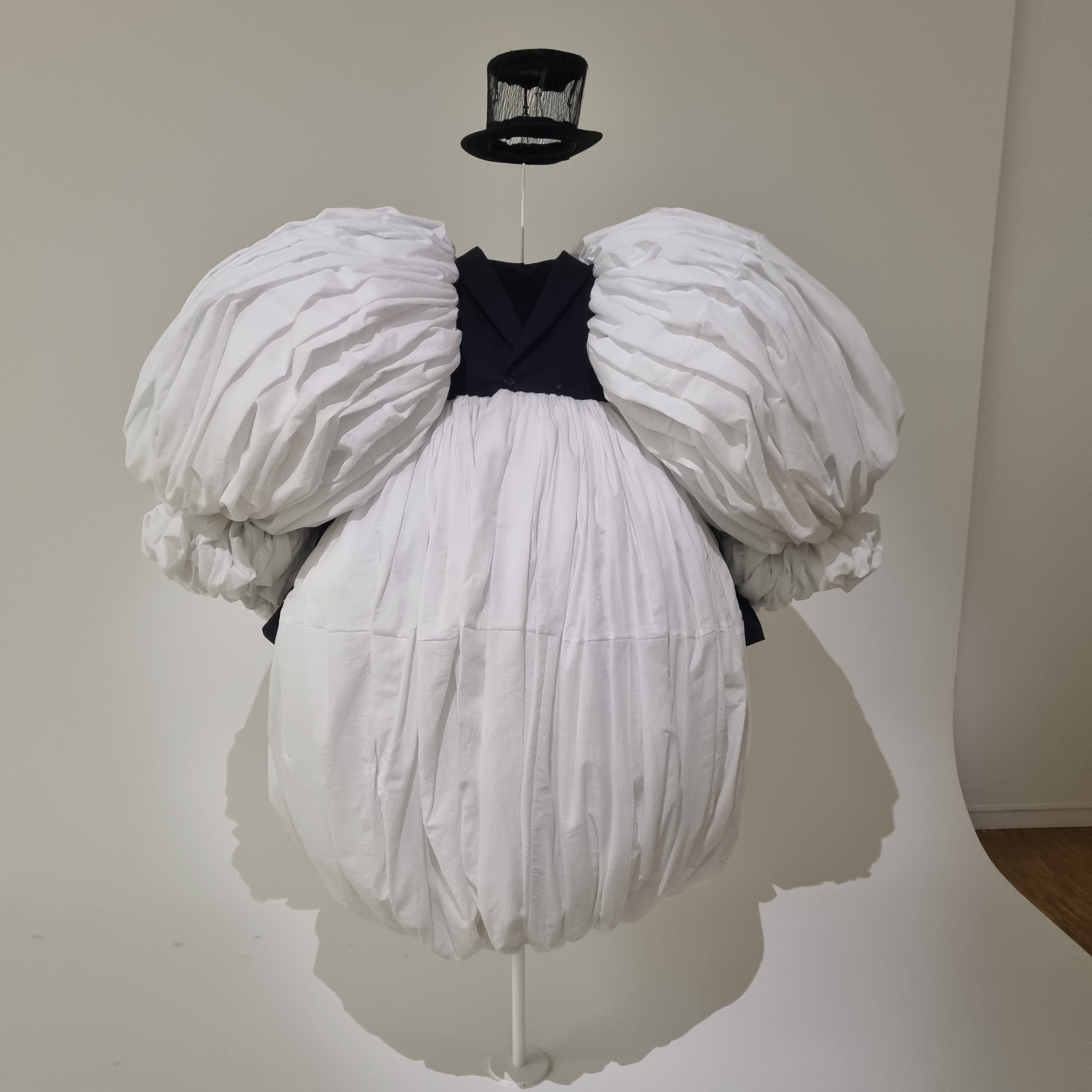
Thrilling…Rei Kawakubo (Comme des Garcons)
The traditional crew, namely elegant ladies in their silk scarves, and beady silver foxes were there, but very much diluted. I discussed this with Florian, a charming man behind the Information counter. He informed me that the audiences were “completely different” from anything the Centre Pompidou had known before, in terms of visitors to the permanent collection. Also, as well as being numinous, they were extremely active on social media. Bingo!
Putting haute couture on a pedestal reminds us that the French have always treasured its rag trade; a point made quite forcefully by Apple TV’s The New Look, which has just launched on the streaming service, with the first four episodes available now. The 10-part show has been criticised for diminishing the horror of the Holocaust with silly French accents and concern about garms, but this is not Zone of Interest. This is a show about Christian Dior, and Jean Balmain, and Coco Chanel, and their actions during the Occupation of Paris.
One of the main issues, voiced by Lucien Lelong (magisterial John Malkovitch) is that if the couturiers cleared out of the city, and cleared their orders for ballgowns from Nazi officers, they would plunge thousands of workers into poverty. They needed to carry on working. Thanks to a Radio Times commission, I was granted access to binge watch the whole lot, and so saw the last episode which lands on April 3, and wraps up the whole story with Christian Dior’s triumphant 1947 collection. The ‘Bar’ suit, which launched the whole New Look trend with its white, waisted jacket and full pleated black skirt is, in material terms, both the pinnacle of the show and representative of the start of Dior’s reign in couture.
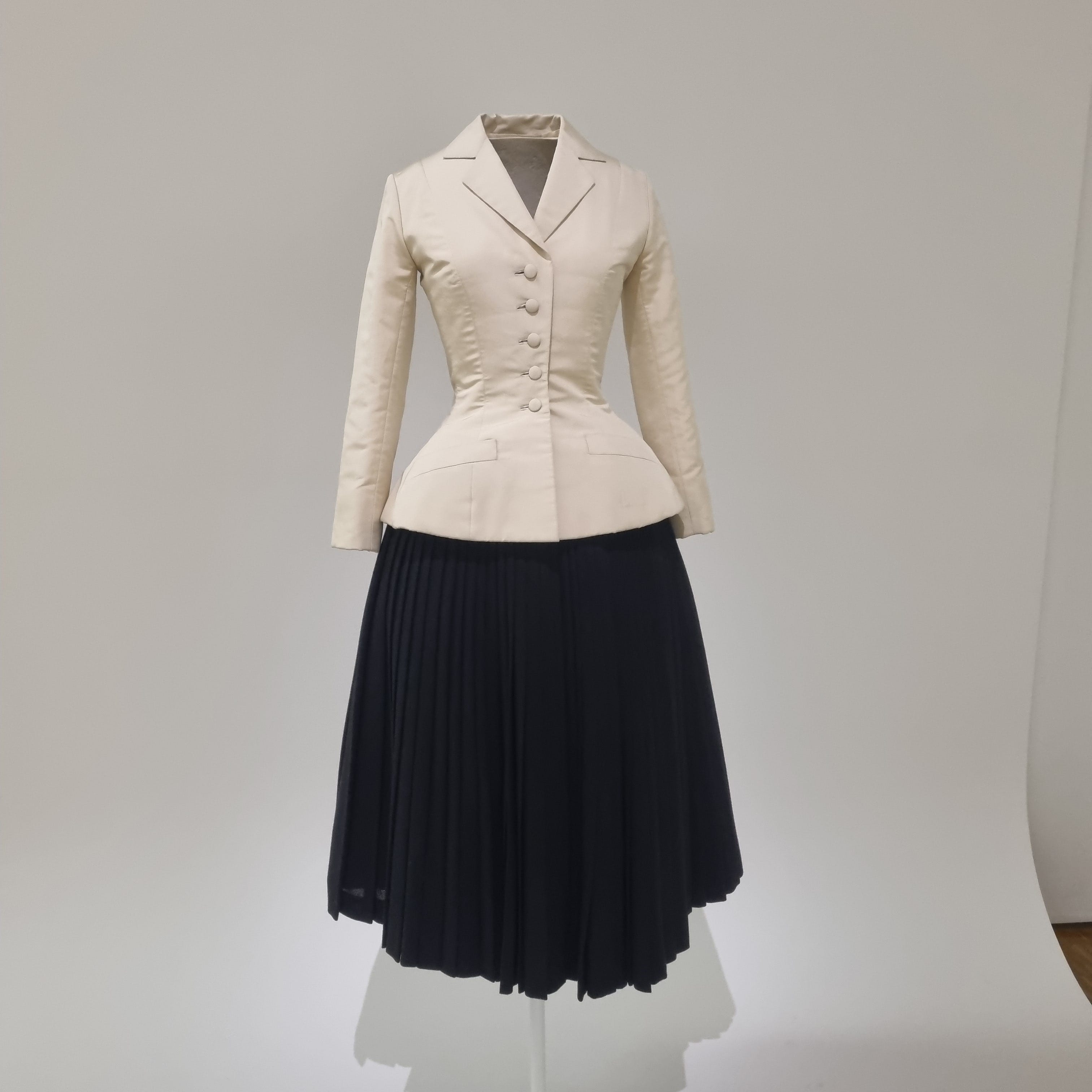
Dior’s iconic ‘Bar’ suit, 1947
I watched the episode one morning last week. In the afternoon, I visited the Centre Pompidou. And lo, following the map of the garments, I came to the actual 1947 suit itself. It is owned by the Dior National Collection, and was brilliantly paired with the equally monochrome White over Black III, by Ellsworth Kelly. Marcel Duchamp, (whose urinal is one of the highlights of the collection here) suggested that the act of putting something in a museum means you looked at it differently. Hence I was able to regard Dior’s Bar suit in the sculptural terms proposed by Kelly, could appreciate its balance and poise, its perfect proportions and its essential femininity.
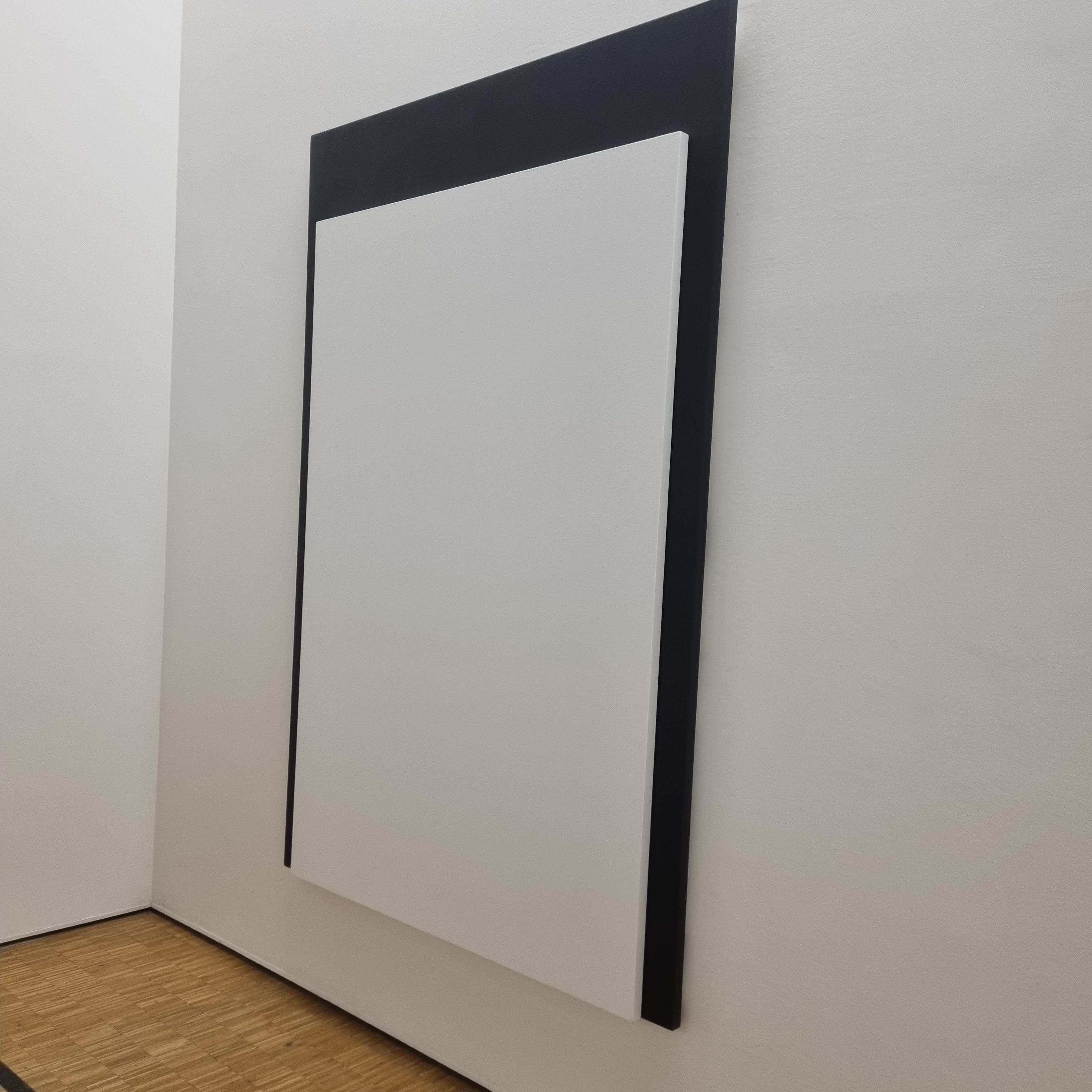
Ellsworth Kelly, meeting Dior’s monochrome
It was the best visit I have ever had to the Centre Pompidou, and I learned a huge amount about modern art from the simple act of looking at it alongside modern fashion. If you’re in Paris between now and April 22, make a beeline to this clever and rewarding show. If not, then try and scoop up The New Look on Apple TV where you will find Juliette Binoche playing Gabrielle “Coco” Chanel as a basic bitch, and Ben Mendelssohn playing Christian Dior as a traumatised artist and brother to his sister and Resistance fighter Catherine (Masie Williams) who almost died after incarceration at Ravensbruck prison camp.
If you are arriving in Paris in July or August for the Olympics, make sure to visit the Centre Pompidou anyway. Florian at the information stand reminded me that the great museum is going to be shut for five years from 2025 onwards, for a giant renovation project thanks partially to dodgy concrete. Get on that outside escalator now.
Our oldest French friend was a primary school teacher in St Etienne. One day she showed me how she introduced art to 6 yr-olds: Manet, Picasso, Matisse. All part of the curriculum. No wonder French millennials aren’t shy of going into galleries.